Tools for design students
I built a tool for design students — a diagnostic that helps them articulate why their concepts hold together or fall apart. It emerged from fifteen years of teaching at NID, Srishti, CEPT, IIT Gandhinagar, and Anant. Real students shaped it. Their confusion became training data. Their questions became architectural decisions. The tool exists because those classrooms existed first.
Now comes the temptation: if the pattern works here, surely it transfers elsewhere. Legal contracts. Medical assessments. Financial evaluations. Technically, the architecture does transfer. But the pattern is domain-agnostic. The tools are not.
A streaming service recommends films based on what you have actually watched, not what you might theoretically enjoy. The recommendations follow your viewing history — they do not precede it. A service that recommends everything equally knows nothing about you specifically. Domain expertise works the same way.
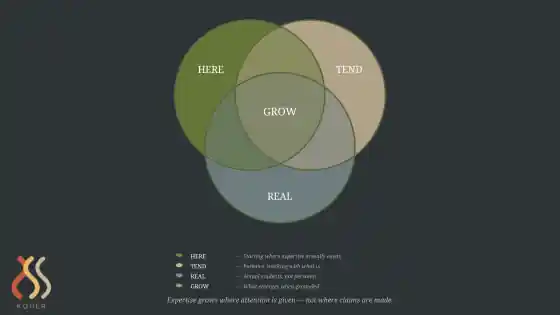
When I ask myself “where does Koher work?”, the honest answer is: in design education. Not because other domains are excluded — but because that is where my fifteen years of pattern recognition actually exist. I can look at a design brief and sense whether it will generate coherent work or scatter into fragments. I cannot do that with a legal contract or a medical diagnosis. Not yet. And perhaps not at all.
This is not a boundary. It is a horizon. A boundary is something you are inside or outside of — it excludes. A horizon is where your vision currently extends — it moves as you move, always receding. Other domains remain possible. They are simply not where the practice is grounded right now.
The temptation is to seem bigger by claiming more. List five domains on the website. Reference potential applications in healthcare, finance, law. But that would be recommendation without viewing history — confidence without the underlying pattern recognition that makes confidence meaningful.
So I am focusing Koher on design students and practitioners. Not as a market segment to capture, but as a recognition of where the expertise actually is. The classroom is my testing ground. The students are real — not personas. The struggles are ones I have actually witnessed, not markets I have imagined.
What the focus permits: genuine depth in a domain I actually understand. What the focus prohibits: performance of significance I have not yet earned.
Where in your practice have you been claiming domains instead of naming where you actually are?