Who agreed that a model would write it?
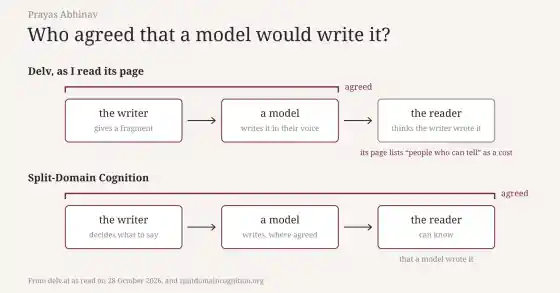
Delv, a writing tool now taking a waitlist, says it turns a fragment such as “tell him no but keep the door open” into the message you would have written, in your voice and to the person you are writing to.
Part of this sits close to my own work. The writer decides what to say and a model writes it, which is the split between judgement and language I have built Split-Domain Cognition and Koher’s tools around.
Where it differs from my work is the person who receives the message. For me, when a model writes something, the person reading it should be able to know that. Delv’s page says nothing about the recipient being told. Among the costs of sounding like a machine, it lists “people who can tell you didn’t write it”, so the aim is that they cannot tell.
Delv could answer that the recipient is reading the writer: their intent, in their voice, sent by them. My answer is that the wording is part of what a close friend takes from a message. If a friend learns that a message in your voice was written by a tool, they have reason to doubt every earlier message from you too.
Delv’s page says it learns from what you have already sent, and that it models the pair: how you write to your cofounder is not how you write to your lawyer or your best friend. That is what someone would need to pass as you to each of them, and nothing on the page says where it is kept. If it leaks or is stolen, someone else can ask your cofounder to move the money, or tell your best friend you are done with them, in the voice each of them knows as yours. Families in India already get WhatsApp messages from a son in trouble that the son never sent. With a model like this behind them, those messages would read like him.
Once tools like this are common, an apology or a condolence in a friend’s voice will no longer show that the friend wrote it, and the person reading it has no way to check.
I think its own argument also works against it. The page says “fluency is free now” and that what is scarce is “the thing that can’t be averaged: your voice”. If a tool can copy your voice, your voice stops being scarce too. The page also plans an open benchmark for “voice fidelity”, how well text reads as one person writing to another, usable, it says, by anyone, including people building against it. That openness is to its credit.
A speechwriter drafts in a minister’s name and nobody is misled, because everyone knows ministers have speechwriters. A message to a friend carries no such understanding. The version of Delv I would trust tells the recipient when it did the writing. Its page does not describe that version.
Delv’s page:
Split-Domain Cognition:
https://splitdomaincognition.org
Write to me: