The architecture has a DOI
The Koher architecture paper is now a preprint. DOI: 10.5281/zenodo.19661700. A peer-reviewed version went to She Ji: The Journal of Design, Economics, and Innovation on 21 April.
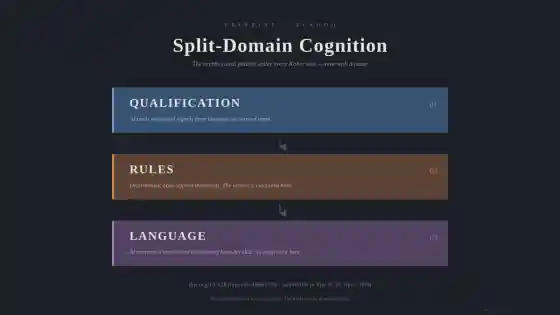
The paper does one thing that mattered more than I expected. It names a pattern. The three-layer structure under every Koher tool now has a term — Split-Domain Cognition. Qualification: AI reads structured signals from language. Rules: deterministic code applies thresholds. Language: AI narrates a verdict that has already been computed. Before the name, each instance looked like a design choice for that particular tool. After the name, the same choice across three tools becomes one architectural commitment.
Naming a pattern is not cosmetic. It is the difference between a recurring annoyance and a ticket you can assign. Engineering teams lose weeks to the same problem until someone files it in an issue tracker and gives it a number; from that point the conversation changes. Split-Domain Cognition is the ticket number for what Koher keeps doing across different tools.
The paper also states something the release-notes prose around AI tools tends to obscure. Recent benchmarks put sycophancy rates above fifty per cent across leading commercial models. That is not a bug waiting to be patched in v4.2. It is structural — a consequence of how models are trained to be deployable through RLHF. A more capable single-pass model becomes a more confident unauditable model. Fluency makes the missing step harder to notice, not easier. You cannot ship your way out of an architectural property.
Three working tools instantiate the pattern — a Coherence Diagnostic, a Play Shape Diagnostic, a Fragment Mapper. Each with a different qualification method and a different rule structure. A student using any of them can see which rule fired, what threshold applied, and what the tool did not look at. That visibility is the contribution. The tools are how it is demonstrated.
The claim is architectural, not pedagogical. Classifier accuracy is measured against the bootstrap corpus. Efficacy on learning outcomes is a longer validation project the paper explicitly defers. What can be claimed now is separated from what remains to be shown, in writing, where anyone can disagree with it.
The code stays MIT-licensed. The paper is CC-BY-4.0. Revisions go up as new versions of the same Zenodo record — the address does not change.
Where has naming a pattern at your work changed what conversations became possible?