RAM
New release. Shared from the Koher page:
Tool release · RAM 0.5 · 15 October 2026 · open source
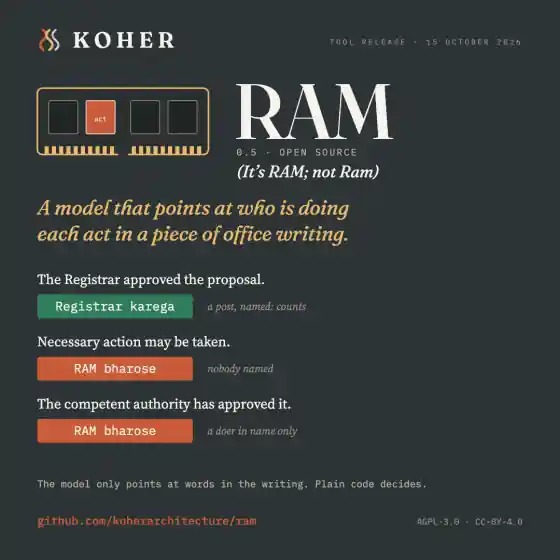
RAM (It’s RAM; not Ram) reads a short piece of office writing, such
as a file noting, and finds each thing somebody has to do in it. For
each act it says who does it, as “
The model inside RAM does not write. A parser finds the acts and code asks one fixed question about each. An extractive reader of 33 million parameters marks the words in the writing that do the act, or marks nothing. Code then refuses doers that name nobody, from short lists anyone can read, and gives the answer. Long writing is read act by act. The answer is for the person who wrote the sentence, on their own draft, and RAM is not for judging anybody else’s writing.
On five test sets RAM reads right all 178 acts it finds; a parser on its own gets 162. All five sets were written by models, and all have been seen. Notings written by people are not yet measured. The README sets out the limits.
The reader is fine-tuned from deepset’s minilm-uncased-squad2, which is built on Microsoft’s MiniLM, and the acts are found with spaCy. It runs on a laptop CPU.
Code, data and model card:
https://github.com/koherarchitecture/ram
The note:
https://koher.app/notes/ram
Code AGPL-3.0 · weights and training data CC-BY-4.0