rai
New release. Shared from the Koher page:
Tool release · rai 0.3.2 · 22 September 2026 · open source
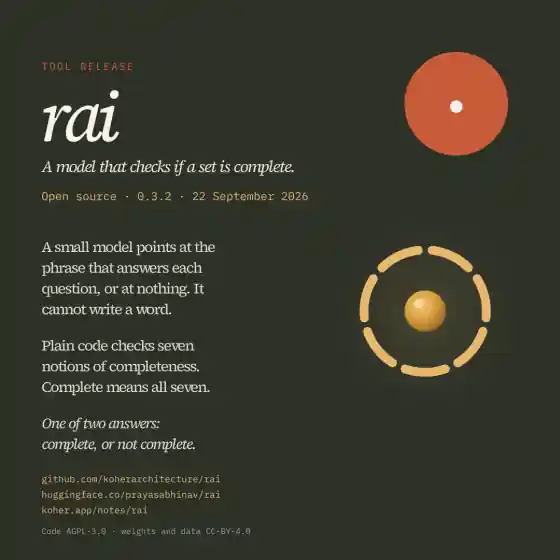
rai is a model that checks if a set is complete. It holds a set of questions about one thing, written before anyone answers. For a stone in your hand: What colour is it? How big is it, against a coin or your thumb? What shape is it? Does it have any mark, crack, line or speck? Where? A person types an answer to each question, and rai gives one of two answers: complete or not complete. It does not say what is missing or suggest wording, and it shows no number.
The model inside rai does not write. For each question it marks the phrase in the typed answer that answers it, or marks nothing. Everything after that step is ordinary code: a short rule sorts each answer into a specific point that can be checked or something that does not count, and a tally checks seven notions of completeness, listed in the repository. The set is complete when all seven pass.
The model has 33 million parameters and runs on a laptop CPU. It is fine-tuned from deepset’s minilm-uncased-squad2, which is built on Microsoft’s MiniLM. Its training data is 12,000 synthetic answers made from templates, none of them written by a person. On a test set kept out of training, it accepts 116 of 180 answers that do answer their question, and none of the 180 that evade the question or answer a different one. The model card sets out the limits of that number.
The idea of a model that returns a fixed, typed answer came from Jev, by TypeSafe, and kev, by Jared Palmer.
Code, data and model card:
https://github.com/koherarchitecture/rai
Weights:
https://huggingface.co/prayasabhinav/rai
The note:
https://koher.app/notes/rai
Code AGPL-3.0 · weights and training data CC-BY-4.0