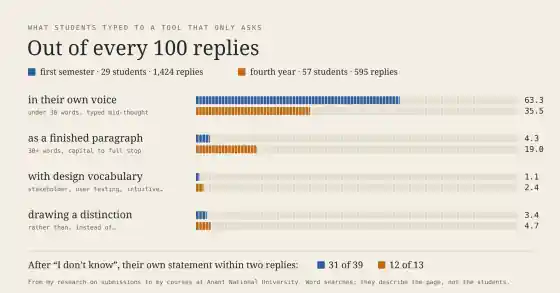
Own voice, per hundred replies
I counted what my first-semester students typed to a tool that only asks questions, and set it beside what fourth-year students had typed to the same tool.
The tool is zetizeti. It asks one short question at a time and never offers an answer or an idea. It keeps nothing anyone writes, so each student downloads their own dialogue and hands it in. Over nine Wednesdays this term, 29 students in the AI Design Studio, a first-semester elective at Anant National University, handed in 51 dialogues with 1,424 replies in them. Beside those I put 595 replies from 57 fourth-year Interaction Design students, handed in by 2 September.
I counted a reply as the student’s own voice when it was under 30 words and typed the way people type mid-thought: starting in lower case, or writing i for I or u for you. Out of every 100 replies, 63 from the first-years were like that. From the fourth-years, 36 were. Finished paragraphs went the other way. A reply of 30 words or more that opens with a capital, ends with a full stop and never writes i for I came 4 times in 100 from the first-years and 19 times in 100 from the fourth-years.
Design vocabulary (stakeholder, user testing) was rare in both groups: 1.1 replies in 100 from the first-years and 2.4 in 100 from the fourth-years. So were replies that draw a distinction with words like “rather than” or “instead of”, at 3.4 and 4.7 in 100.
The first-years wrote that they did not know, or did not understand a question, 39 times. Each time the tool asked another question instead of answering. In 31 of those 39, the same student wrote a statement of their own, eight words or longer, within the next two replies. The fourth-years said they did not know 13 times, and went on to a statement of their own in 12.
The figures come from my own research on what students handed in to my courses at Anant National University. They are word searches, and they describe what is on the page, not the students. The two groups are not a clean comparison. The fourth-years used an earlier version of the tool and worked through a preparation sheet over three sittings, and they wrote about 10 replies each, where the first-years wrote about 50. Eight first-years have at least one finished-paragraph reply, and for two of them it is a quarter of their replies or more. The files do not show whether a student typed those replies or pasted them in from somewhere else.
No student’s words are quoted here, because the dialogues were handed in as coursework and the tool kept no copy of them.
zetizeti:
Write to me: