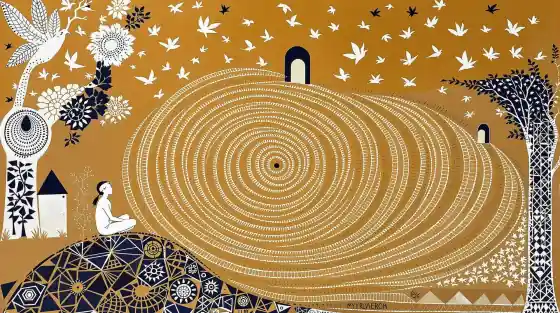
Work With What You Don't Know
A student sits before me, convinced his youth is a creative disability. “I haven’t experienced enough to write,” he says, as if creativity were a warehouse requiring inventory. I tell him something that sounds like a koan: work with what you don’t know. This is not consolation; it’s methodology.
Consider the peculiar archaeology of creative work. A sculptor doesn’t know what lies within the stone until the chisel reveals it. A novelist discovers their characters’ motivations through the act of writing, not before. The blank canvas teaches the painter more than any colour theory textbook. We call this process “creation” but it’s really controlled excavation of ignorance.
Here’s the uncomfortable truth: expertise in creativity is expertise in navigating the unknown. The more seasoned artists become, the more deliberately they court confusion. They develop sophisticated methods for not-knowing. They build studios that are essentially laboratories for productive bewilderment. Watch a master ceramicist at the wheel – they’re not executing a plan so much as negotiating with clay’s unpredictable nature.
This inverts everything we’re taught about knowledge and authority. In most fields, you accumulate facts like collecting stamps. In creative work, you accumulate techniques for dancing with darkness. The young writer’s perceived limitation – not knowing enough – is actually the raw material. Their unfamiliarity with literary conventions might produce the most startling metaphors. Their inexperience with heartbreak might imagine it more vividly than memory ever could.
Sensitivity and empathy aren’t about understanding others through the lens of our experience. They’re about recognising the vastness of what we cannot know about another consciousness, and building bridges across that void anyway. The creative act mirrors this: acknowledging the abyss, then constructing something provisional and beautiful to span it.
Perhaps the real question is: why do we mistake creative work for documentation when it’s actually divination? What if every poem, painting, and design is less a statement of knowledge and more a question posed to the universe? Maybe youth, with its vast territories of unknowing, is not creativity’s obstacle but its most natural state.