Koher builds tools that separate language from judgment — AI reads text, code applies rules, humans decide. The tools demonstrate this architecture technically, in working code. But what does constrained judgment actually feel like from the inside?
This is the question behind Koher Venue — a space for art that embodies the architecture. The tools show what separation means. The venue lets you feel what it addresses. Each quarter, a new interactive work opens — each exploring a different facet of how we evaluate, decide, and are evaluated in return.
The first work is now live. It is called "You Are The Model." The title is not metaphorical. For a few minutes, you become what the model is.
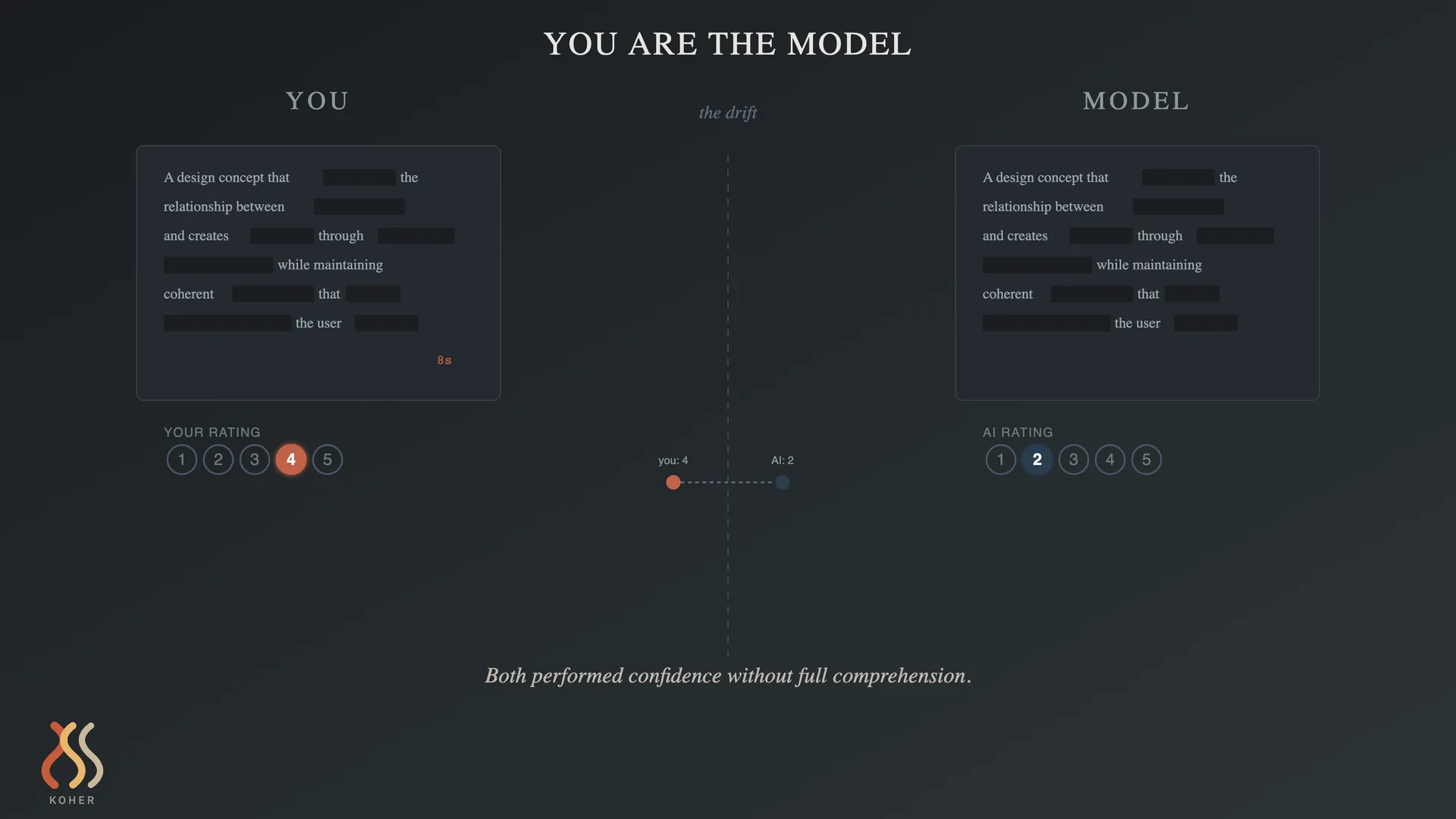
Here is the setup. You see a design concept, but roughly half the words are redacted. Black bars where meaning should be. You have eight seconds. You must rate it — one to five. You cannot say "I don't know." The timer expires whether you decide or not. You must rate even when you are guessing.
After ten rounds, you see your ratings alongside an AI's. The AI saw the same redacted text. It also had to rate under the same constraints. Neither of you had full access to the meaning. Yet you both produced numbers anyway.
The drift between your ratings and the AI's is worth noticing carefully. Sometimes you diverge sharply — you rated high, it rated low. Sometimes you align unexpectedly — the same score, for the same half-visible concept. But the drift is not the central revelation. What matters is what the drift reveals about the process itself.
The revelation is the underlying similarity. Both of you rated under constraint. Both of you performed confidence without full comprehension. We judge incomplete things constantly — interviews, proposals, pitches, portfolios. The incompleteness is usually invisible. The redaction makes it visible and literal.
This complicates our assumptions about judgment. We treat human judgment as complete and AI judgment as partial. But both operate under constraint. Both produce confident outputs from incomplete inputs. The venue makes this visible.
This is why Koher separates language from judgment in its tools (https://koher.app). If both humans and AI perform confidence under constraint, the architecture must make that constraint explicit — auditable rules between recognition and decision.
The work is live now at https://venue.koher.app — four minutes. What have you recently judged without realising how little you actually saw?