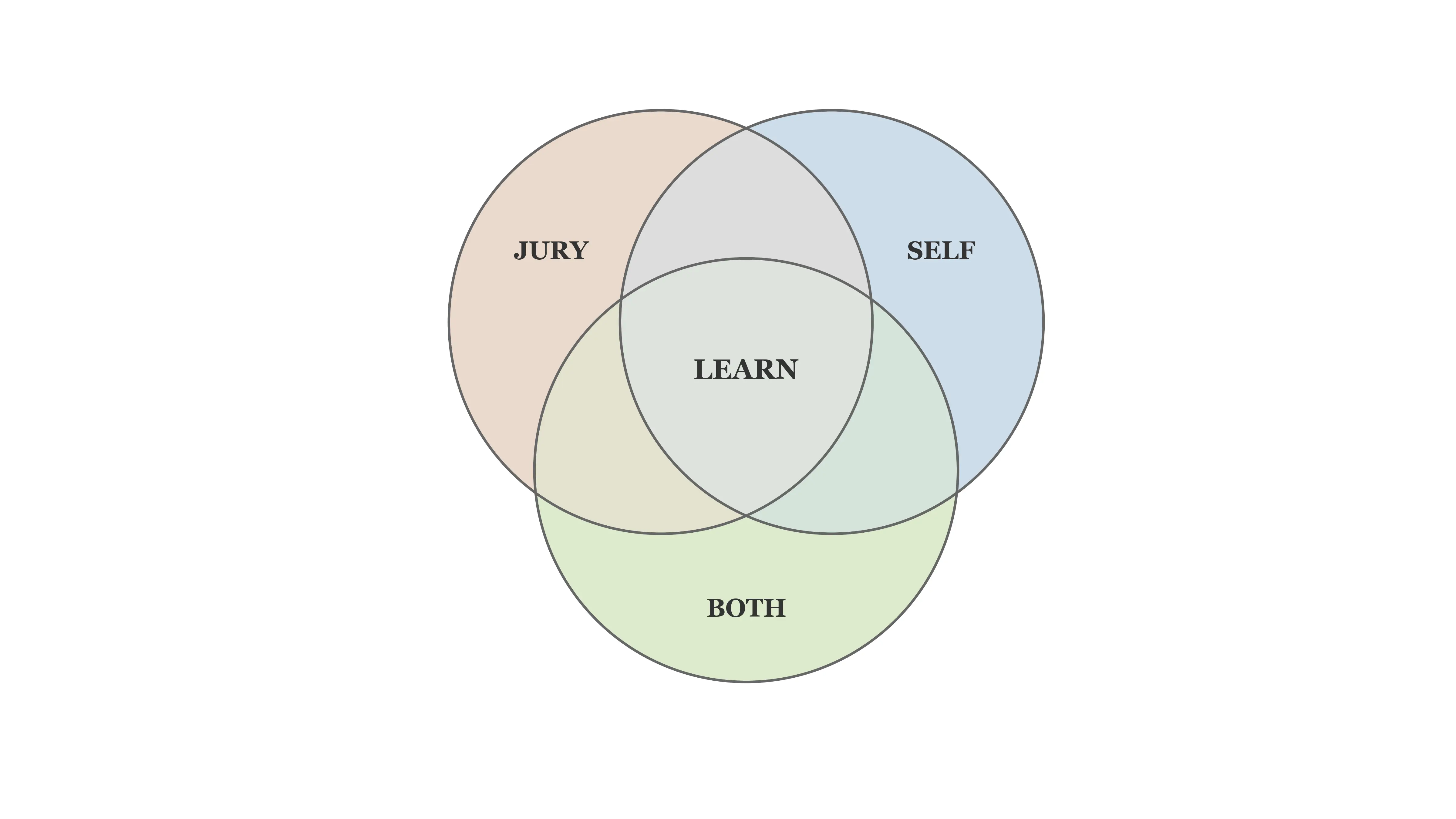
Design education operates through continuous exposure to critique cultures without teaching students to evaluate coherence in their own concepts. This imbalance—privileging external validation whilst treating self-evaluation as aspirational rather than teachable—extends professional development unnecessarily.
External validation matters. Expert critique reveals blind spots, challenges assumptions, calibrates judgement against seasoned perspectives. The problem isn't relying on external feedback—it's treating internal evaluation as something mysterious rather than a teachable method.
Watch what happens in a typical design jury. Students present concepts. Jurors offer critique—"lacks cohesion," "feels disconnected." The student absorbs judgements, iterates, returns. After sufficient cycles, some develop "an eye for good design." But what happened? They've internalised approval patterns through exposure without learning explicit coherence criteria.
Coherence evaluation isn't spiritual intuition. It's a science. Students can learn to detect definitional gaps, scope violations, internal contradictions, and evidential insufficiency in their own concepts before presenting them for external review. This doesn't replace expert critique—it makes critique more productive because the work arrives at a higher baseline of structural integrity.
Educational philosophy already possesses the vocabulary—metacognitive awareness, reflective practice, critical self-assessment. But these remain aspirational framings rather than core competencies with explicit curricula. We gesture towards self-reflection whilst structuring education entirely around external validation, as if the two were incompatible rather than complementary.
The guild model functioned when design operated within stable aesthetic conventions. Contemporary design demands conceptual originality across unstable problem spaces where explicit evaluation methods matter more than absorbed patterns.
Balance requires both perspectives. External critique without internal evaluation produces dependency. Internal evaluation without external calibration produces insularity. Teaching coherence evaluation as explicit method whilst maintaining robust critique cultures produces designers who assess structural integrity and remain open to external perspectives.
What evaluation methods do you use to check your own work before seeking feedback? Were these taught explicitly or absorbed through years of exposure?
#DesignEducation #Coherence #SelfReflection #DesignCritique #Pedagogy #StructuralAnalysis #Metacognition #PeerReview #EducationalPhilosophy #ProfessionalDevelopment