Tomorrow, they arrive.
Beings whose minds eclipse ours as profoundly as ours surpass the octopus, the pig, the cow. They observe our factories where sentience is measured in profit margins. Our laboratories where suffering is a variable in an equation. Our entertainment venues where consciousness performs for applause.
They take notes.
Not with malice, but with the same detached curiosity we reserve for "lesser" beings. They see a species that has mastered the architecture of justification—necessity, tradition, natural order—each brick laid carefully to wall off empathy at precisely the species line.
What precedent have we set?
In boardrooms, we optimize suffering for efficiency. In courtrooms, we debate whether intelligence determines worth. In living rooms, we teach children to love some animals and consume others, drawing arbitrary lines through the kingdom of consciousness.
The aliens understand hierarchies. They've studied ours meticulously.
Perhaps they'll house us efficiently, maximize our productivity, argue that our protests are merely involuntary responses—not true suffering as they define it. Perhaps they'll note that we established the principle ourselves: cognitive superiority grants dominion.
Or perhaps, if we're fortunate, they'll have evolved beyond the moral framework we've enshrined—one where might makes right, dressed in the language of reason.
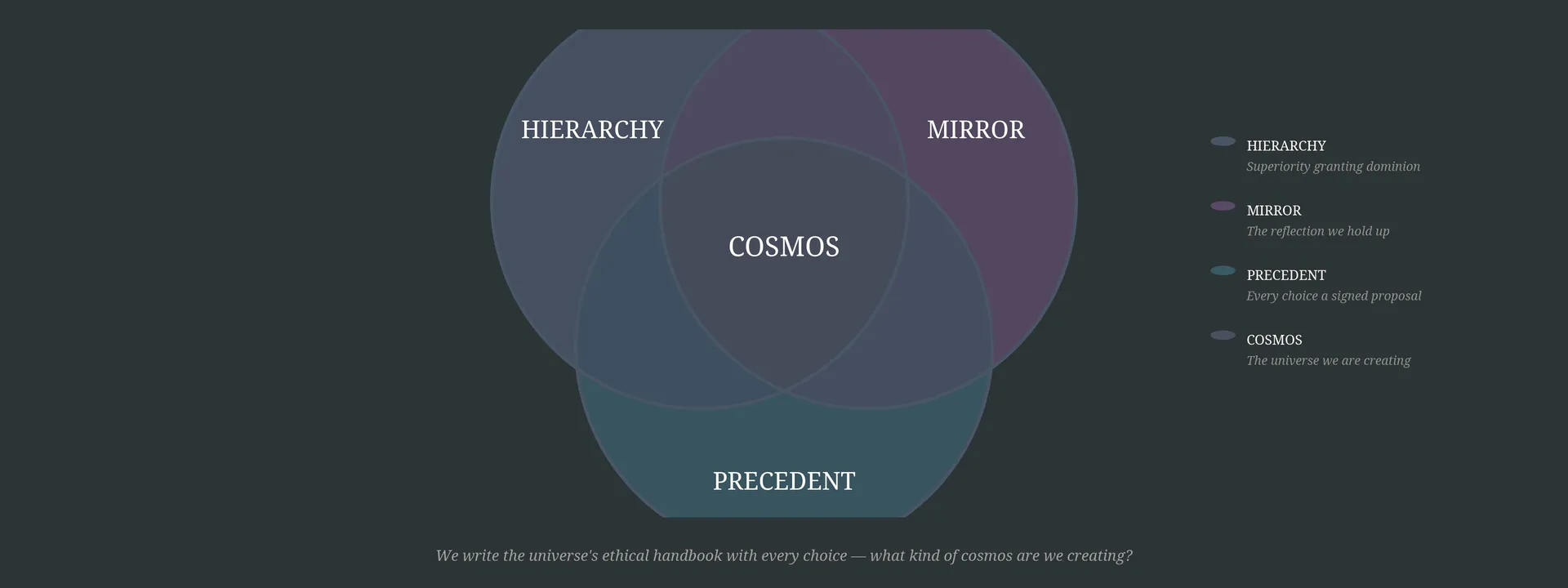
The mirror we hold up to the cosmos reflects more than we intend.
Every factory farm (or local dairy - it is the same thing at different scales) is a cosmic ethics proposal. Every laboratory animal, a precedent. Every circus elephant, a signed permission slip for our own potential captivity.
We are writing the universe's ethical handbook with every choice, teaching unknown civilizations how beings like us deserve to be treated.
The question isn't whether we're alone in the universe.
The question is what kind of universe we're creating with our choices—and whether we'd want to live in it from any other position in the hierarchy.
Tomorrow is always closer than we think.