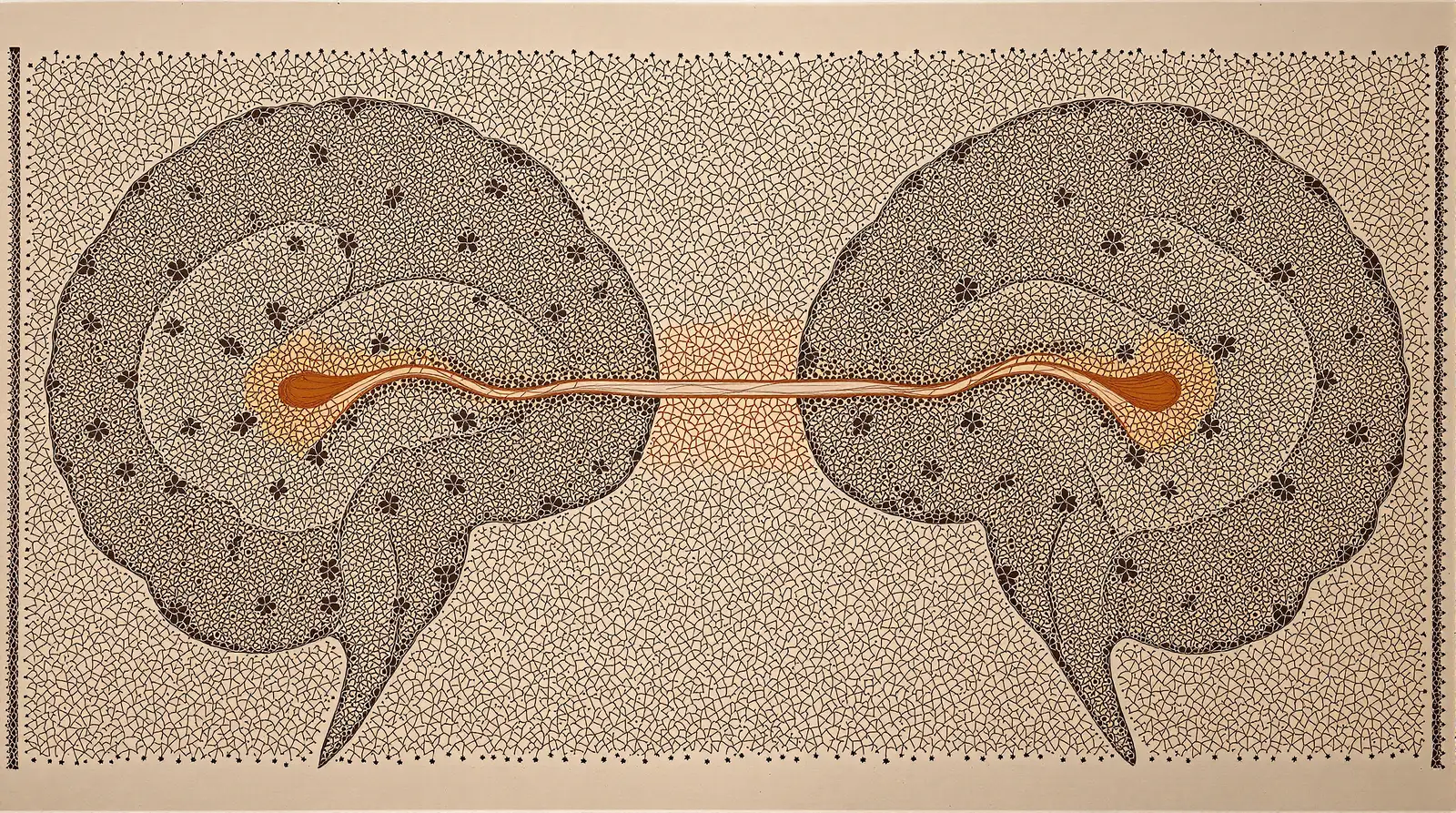
You inhabit one brain, experiencing one continuous stream of "you." This seems inevitable—consciousness bound to a single skull like a river confined to its bed. Yet what creates this unity? Two hundred million nerve fibres span your hemispheres, exchanging information with the density of a monsoon. When surgeons sever this connection, something extraordinary emerges. Split-brain patients show two consciousnesses in one body—one hand buttons a shirt whilst the other unbuttons it. The person reports feeling singular, yet their hands negotiate separate realities. Unity arises from bandwidth, not essence.
Consider conjoined twins sharing circulatory systems, digestive organs, a single liver filtering blood for two distinct minds. Shared flesh doesn't merge consciousness. If surgeons grafted a second complete brain onto your body, you wouldn't suddenly experience both streams simultaneously. Two persons would inhabit one vessel, each locked within their own experiential chamber, as isolated as neighbouring houses sharing a wall.
Your brain functions less like a monarchy with one ruler than like a bustling city—different districts handling vision, memory, movement, each operating with partial autonomy. Visual processing alone spans multiple regions: early areas detect edges like apprentices sorting raw materials, higher centres assemble these into recognisable faces like master craftspeople completing intricate works. The orchestration happens without a conductor. Distributed regions compete and cooperate dynamically, like market vendors negotiating prices, creating functional coordination through continuous interaction rather than top-down control.
This reveals something peculiar. If coordination spans multiple regions within one skull through rich communication, why couldn't it span multiple skulls? Current biology lacks the infrastructure. Your hemispheres communicate through massive fibre bundles