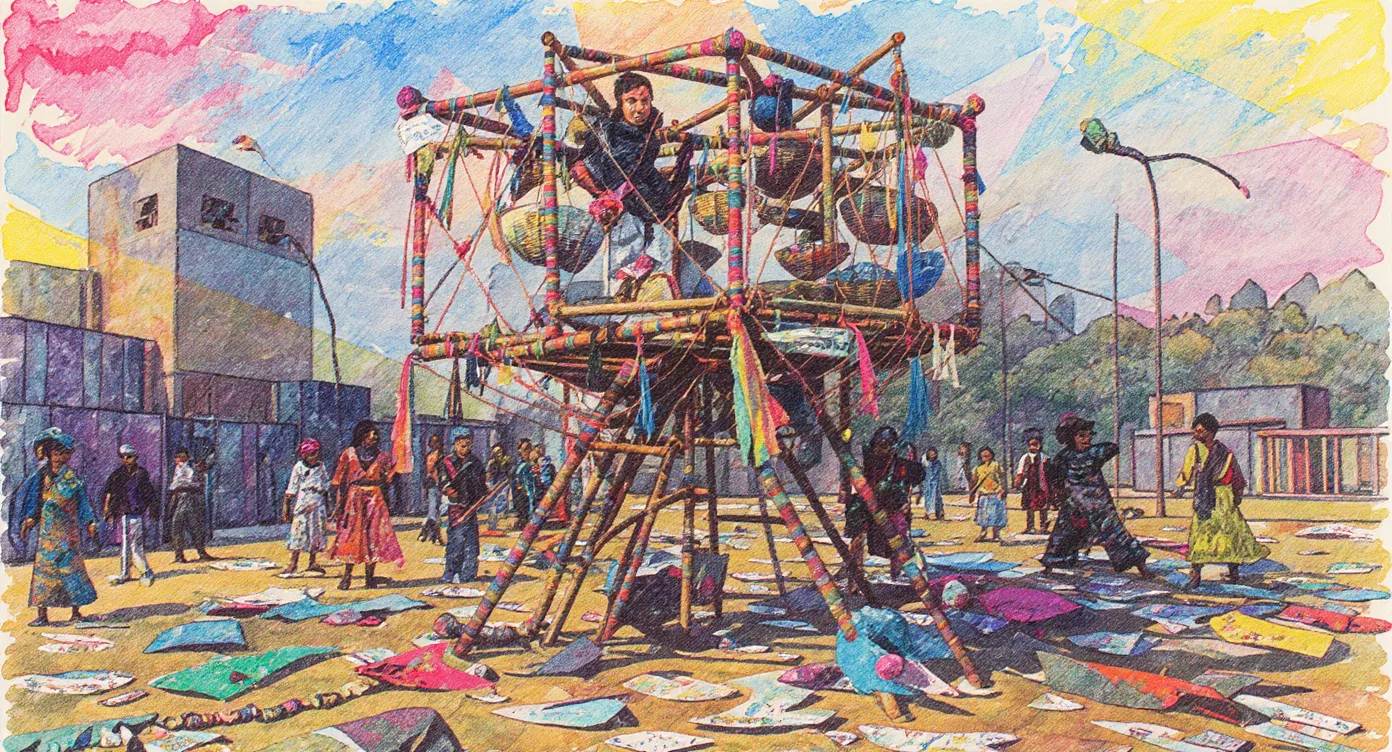
A blade grows dull against silk, sharp against stone. Our urban lives have become silk-smooth motorways of convenience, gliding us from comfort to comfort whilst our sensitivity to the world beyond our bubble grows progressively numb.
I spent years staging urban interventions designed to place rough stones in these smooth paths. Not as obstacles, but as teachers. Picture the city as a vast amphitheatre where all of life's dramas unfold—yet most of us traverse it like sleepwalkers, insulated by earbuds, apps, and algorithmic recommendations that predict our every need before we feel it.
What happens when we deliberately introduce friction into this frictionless existence? When we strip away the comfortable "me-centric" navigation systems and force ourselves to negotiate the commons differently?
Something remarkable emerges. Like a hall of mirrors suddenly cracking, our perspective multiplies. We begin to recognise how others navigate the same spaces with entirely different resources, challenges, and realities. The homeless person's relationship with public seating. The elderly woman's experience of digital payment systems. The migrant worker's invisible labour maintaining our seamless urban experience.
This is not about manufactured difficulty for its own sake. It's about cultivating what I call "productive discomfort"—the sweet spot where designers discover problems they never knew existed. Most creative professionals spend enormous energy trying to understand user needs through research and empathy exercises. But what if we simply made ourselves slightly more vulnerable to the urban condition itself?
Public art and intervention become tools of un-smoothing. They create momentary breaks in our automated responses, forcing us into interpersonal space where creative solutions emerge organically. The city transforms from backdrop to collaborator, from stage to co-creator.
What if our pursuit of seamless experience is actually creating seams we cannot see? Perhaps the real question is whether comfort always serves creativity, or whether our frictionless futures might be grinding away our capacity to recognise friction in others' lives?