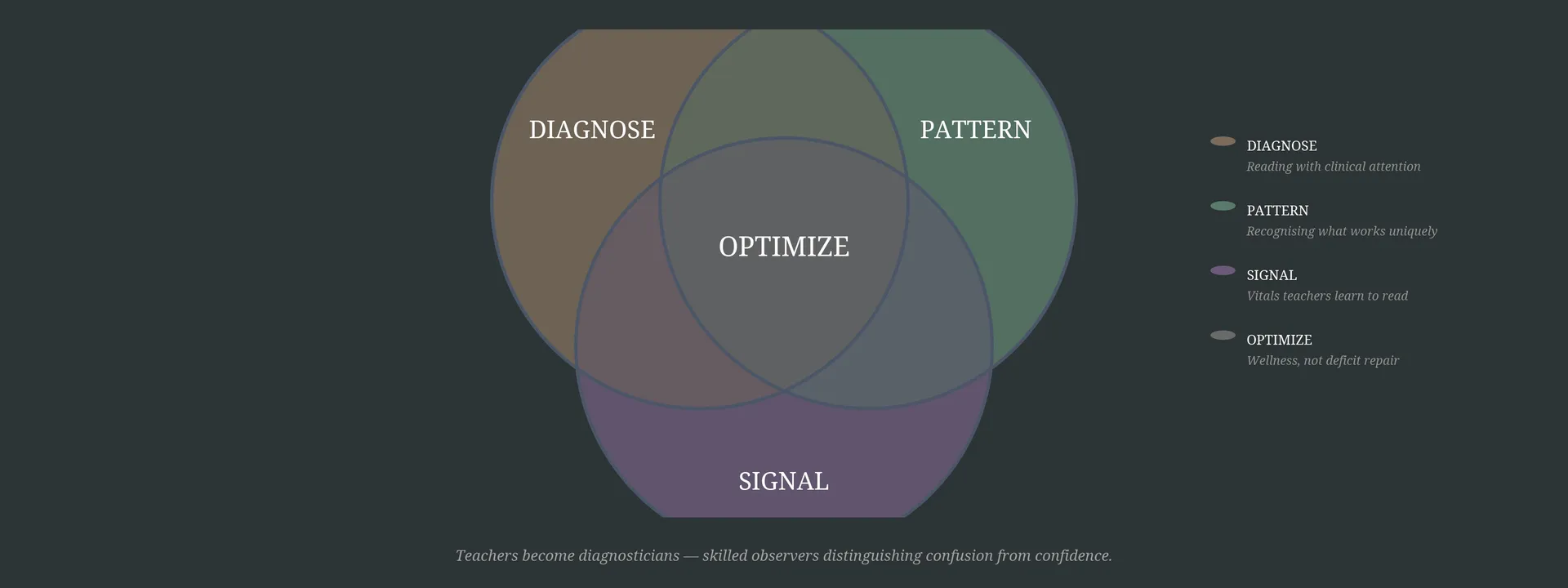
A thought experiment: What if we approached classroom learning with the diagnostic precision of medicine—minus the pathology?
Consider how doctors observe patterns and personalize treatment. Now imagine teachers trained in similar protocols, not to identify illness, but to map each student's unique learning patterns.
The parallel is striking. Both learning challenges and medical conditions benefit from early detection, personalized intervention, and differential diagnosis. Is a student struggling with the concept itself or with confidence? The answer changes everything.
This model would transform classrooms into learning labs with diagnostic, practice, and application stations. Teachers would conduct morning "rounds," checking comprehension and emotional readiness. Students would maintain portfolios documenting what works for them and why.
The key distinction: we're optimizing wellness, not treating deficits. Think warm pediatrician's office, not emergency room—careful attention without anxiety.
Most significantly, this reframes the teacher's role entirely. Rather than information deliverers, teachers become learning diagnosticians—skilled observers who can distinguish whether confusion stems from missing prerequisites, conceptual blocks, or confidence issues. Their value shifts from what they know to how well they read and respond to learning signals.
This mirrors medicine's evolution toward specialization. Teachers might develop specific diagnostic expertise—one for mathematical thinking patterns, another for language acquisition blocks. Senior teachers would mentor junior ones, creating a teaching hospital model where expertise is continuously refined.
One could imagine specialized learning clinics emerging outside schools. A reading comprehension clinic. A mathematical confidence center. Test anxiety practice. Not remedial centers but optimization spaces—like athletes visiting sports medicine clinics to enhance performance, students would visit learning clinics to refine cognitive strategies.
Students would actively co-design their learning pathways, tracking their own "learning vitals" and participating in educational decisions. This isn't about digitizing education or surveillance—it's about systematic observation and personalized response using human skills that predate our technological moment.
Infrastructure needs would be minimal: fabric dividers, tracking sheets, visualization boards. The real investment would be in training teachers to recognize patterns with medical-level rigor.
Could we translate healthcare's precision to education without importing its anxieties? Could we create spaces combining clinical attention with creative joy?