We have to tell someone—at least one person—about who we really are. The risk is that we will ourselves start believing that we really are who we pretend to be. We might forget who we really truly are. This is not some script for some psychodrama. It is a very real risk.
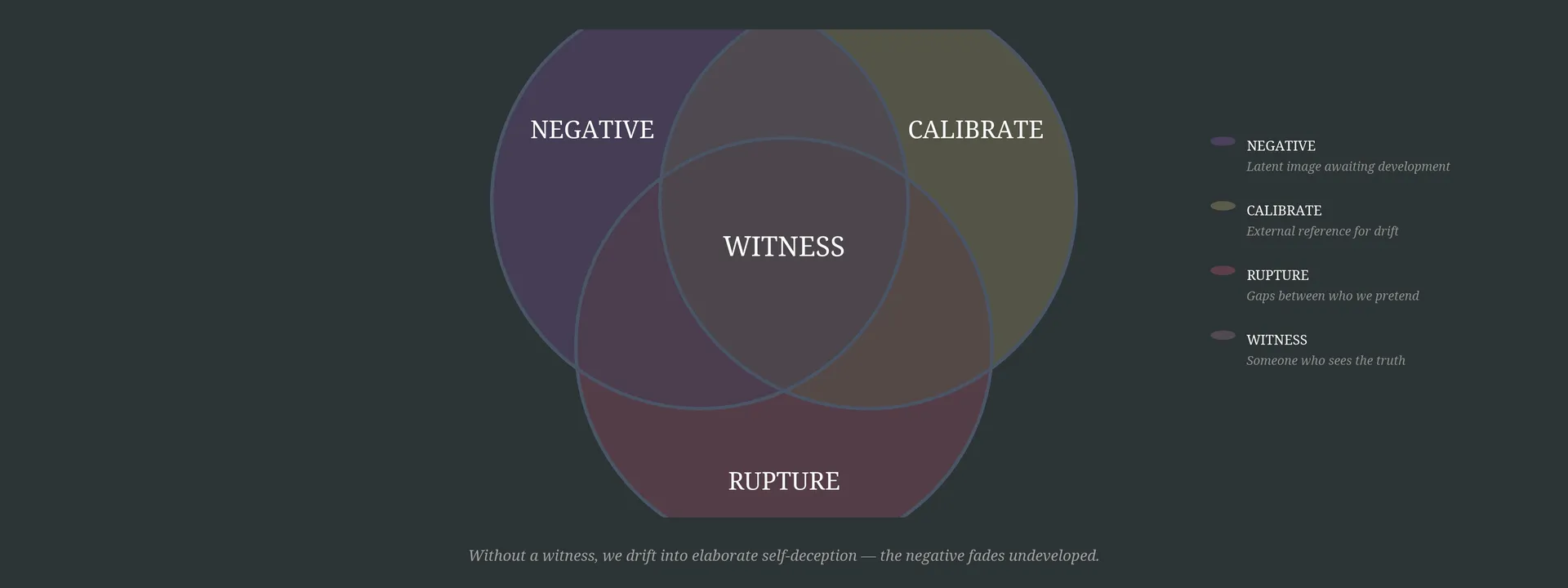
Photographic negatives require external chemistry to become visible. The image exists on the film, latent and complete, but without developing solution it remains invisible—even to itself. Leave it untreated and the image fades entirely, as though it never existed at all. We know ourselves through the ruptures between who we pretend to be and who we really are. If these ruptures do not happen, even we do not know that there is a gap between the two facades.
We are not good at applying these filters ourselves. Scientific instruments drift from calibration—thermometers read high, scales tip heavy, compasses point askew. Self-calibration proves impossible because the instrument has no external reference. A thermometer reading three degrees high cannot know it is wrong. Recalibration requires a known standard outside its own measurement system.
If somebody else knows this (like a confidant) and they can show us the mirror every now and then, it becomes easier. Every time they show us a mirror, we start noticing the ruptures. They verify the temperature we're reading matches what exists. They confirm whether our compass still points toward magnetic north or whether we navigate by invented orientations, mistaking personal preference for cardinal direction.
The confidant witnesses the ruptures we cannot perceive alone. Without external verification, we drift into increasingly elaborate self-deception through the mathematics of isolated measurement systems gradually losing accuracy.
What becomes unbearable is complete convergence—when no rupture occurs because no difference remains. When pretence has colonised the interior so thoroughly that even the confidant finds no gap to reveal. This represents not integration but erasure, the photographic negative left undeveloped so long that the latent image has faded, leaving only blank film where a self once existed.
Can we claim to know ourselves if that knowledge exists only in private, unverified? Does authenticated selfhood require external testimony, someone who has seen the ruptures and confirms that yes, a difference persists? And if we lose that witness, do we lose access to our own reality, like an instrument adrift from calibration, reading temperatures that exist nowhere except in its own increasingly unreliable perception?