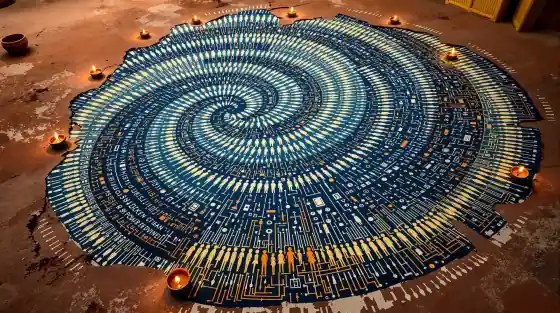
A Broken Compass Pointing Towards Impossible North
Democracy has always been a broken compass pointing towards an impossible north. We built it knowing it would malfunction, yet we persist in following its trembling needle through the digital wilderness. Think of it as a vast amphitheatre where everyone gets a microphone, but the acoustics were designed by engineers who never studied sound.
Look at this platform, or any digital town square we’ve erected in cyberspace. We wanted the ancient Greek agora but got a hall of mirrors where each reflection shouts louder than the last. The paradox sits heavy as mercury in our hands: we crave openness while yearning for curation, demanding both anarchist freedom and choreographed precision.
Social media algorithms are invisible puppeteers, their strings made of ones and zeros, pulling us into dances we never auditioned for. These platforms need rules like cities need traffic lights, but who decided red means stop? What if amber meant contemplate, green meant connect deeply rather than simply go? The current logic is a popularity contest where the prize is more popularity, a snake swallowing its tail while we applaud.
Picture influence as currency in a economy where inflation has made millionaires of people selling empty boxes wrapped in beautiful paper. The algorithm rewards the loudest echo, not the most profound thought. We’ve created digital kingdoms where court jesters wear crowns while philosophers sweep the floors. The profusion of hollow vessels making the most noise isn’t just problematic; it’s the logical conclusion of a system that measures worth in clicks, treating attention like oxygen in a room where everyone’s hyperventilating.
Perhaps democracy online isn’t broken; perhaps it’s working exactly as designed, revealing the uncomfortable truth that given a choice, we often choose the candy over the vegetables, the spectacle over the substance. The system is a perfectly functioning machine producing exactly the chaos it was built to produce.
So we hack it. Not with manifestos but with code. Small groups are already building parallel systems, alternative protocols, weird little experiments in digital governance. They’re not trying to fix democracy; they’re forking it. Creating spaces with different physics entirely. Platforms where your influence decays unless you contribute something new. Algorithms that randomly amplify unknown voices. Networks that make you solve puzzles to post. Bizarre? Yes. But so was democracy when someone first suggested peasants should vote.
The interesting work isn’t happening in the main branch anymore. It’s in the pull requests nobody’s reviewing, the repos with seven stars, the protocols running on raspberry pis in someone’s closet. The real experiment isn’t about fixing the old machine but building strange new ones until something unexpected works.