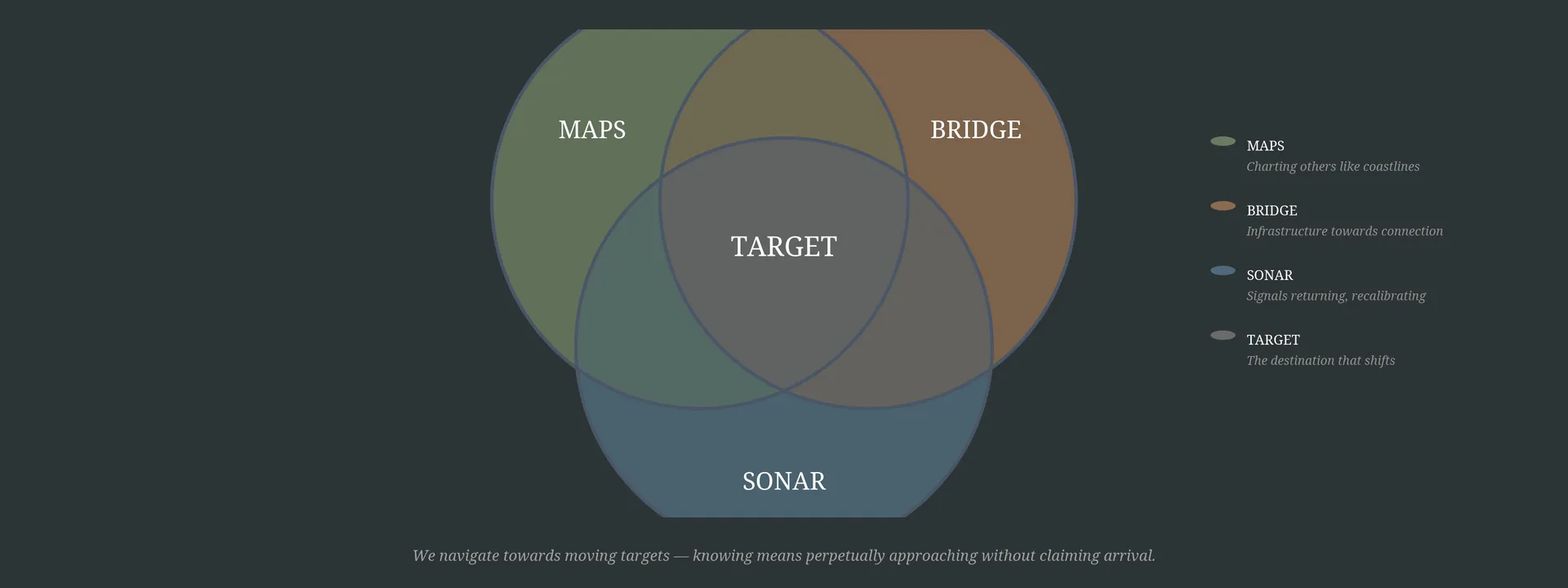
We set out to know another person the way cartographers once mapped unfamiliar coastlines—charting what appears visible, assuming the interior follows predictable contours. Except human beings possess no stable geography. The bridge you construct towards me arrives somewhere, but rarely where you intended.
This is the peculiar infrastructure of interpersonal connection: we cannot see the destination before we build towards it, and the destination itself shifts as we approach. Like a surveyor mapping fault lines, you register tremors attempting to triangulate my position, never certain whether detecting my location or echoes bouncing off what I've placed between us.
Very few people arrive where they believed themselves heading. Most occupy approximations bearing little resemblance to the territory they believe they've mapped. These incomplete maps generate real consequences. Someone builds understanding from partial data, then acts with conviction whilst navigating a landscape existing in their construction.
You've experienced this: the friend who "knows you well" yet misinterprets your silences, reading withdrawal where you're practising patience. The family member whose model calcified fifteen years ago, relating to a fossil whilst you've undergone metamorphosis.
We cannot issue corrective maps to everyone who's navigated towards us with faulty instruments. The bridges built towards us become part of our lived experience whether we endorsed their construction. We inherit the consequences of other people's cartography.
Which inverts the problem: perhaps the bridge metaphor misleads from the beginning. Bridges suggest solid infrastructure. But what if interpersonal knowing operates like sonar—sending signals, interpreting echoes, constantly recalibrating based on reflections revealing more about the geometry of what's reflecting? What if being known requires accepting that others navigate towards moving targets?
The person who truly knows you isn't the one who's constructed the most elaborate bridge. It's the one who's learnt when their maps no longer correspond to terrain, who rebuilds understanding each time you've shifted, who accepts that knowing you means perpetually approaching without claiming arrival.
Can we distinguish between being known and being confidently misunderstood if both produce the same certainty? What would change if we admitted that interpersonal bridges are provisional systems requiring reconstruction, never landing where either party intended?